Well, jedi are essentially magicians so they would be fantasy based unless you're talking about just lightsabers rather than the force, in that case, I wouldn't argue with you, although lightsabers are somewhat implausible by science as we know it. The force can't be seen as a paranormal ability since it's not really a psychic ability but rather an omniscient deity-like all encompassing entity... I'm pretty sure that's beyond scientific understanding.Aean said:Science Fiction - (Noun)theemporer said:The thing is that Science Fantasy is still fantasy more than sci-fi since it can't happen in real life.
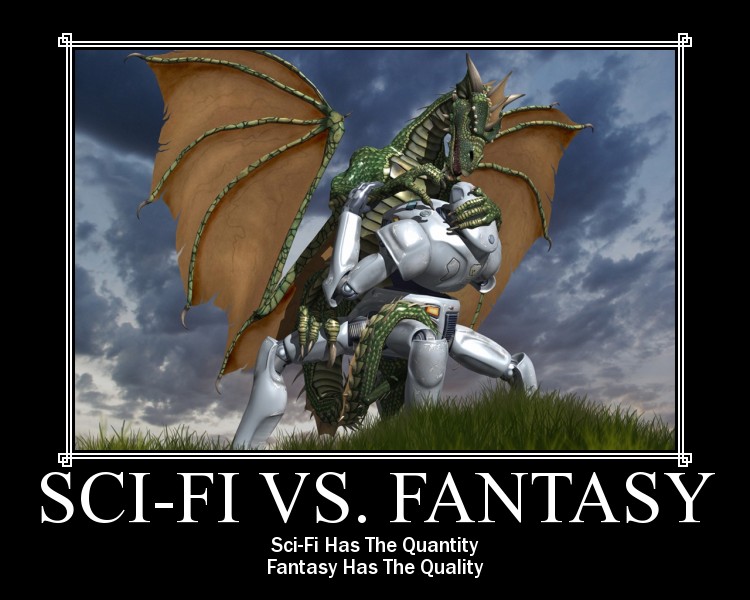
So, science fiction has giant mechs... and science fantasy (which is fantasy) has giant magical mechs. Shaped like dragons.
Edit: Fantasy wins btw.
- a genre of fiction dealing with imaginary but more or less plausible (or at least non-supernatural) content such as future settings, futuristic science and technology, space travel, aliens, and paranormal abilities.
Super Natural
1.(of a manifestation or event) Attributed to some force beyond scientific understanding or the laws of nature
I'm pretty sure that means that we are still allowed to classify Jedi, Protoss, and the Zerg as "Sci-Fi". Actually, even dragons and the like could be considered science fiction if placed in the proper context.
The protoss and Zerg, while I admittedly don't know much about Starcraft, are aliens and don't have truly unrealistic abilities as far as I know so, yes, they would be considered sci-fi. Dragons aren't really the most impressive of fantasy entities, or at least the basic ones aren't. A sci-fi dragon would have to base its abilities off of what's scientifically plausable. Therefore, the most that it could be believed to develop would be fire breath and that would be extraordinary. A fantasy dragon could have 20 heads, each using a different form of breath, each more deadly than the last. And be magical. And immortal. And a god. That is why fantasy would defeat Sci-fi in a battle. Sci-fi has to be plausible. Fantasy doesn't.











 My inner-fanboy is pleased with this thread!