Why I don't agree with calculators replacing long-hand

Recommended Videos

Alssadar

Senior Member
Sep 19, 2010
809
0
21
As a college student who is currently chugging my way through Chemistry web homework(Well, now procrastinating), I am fine with having calculators. Of course, this is for multiplying, dividing, and adding numbers with half a dozen significant digits, so that's pretty taxing.
As a mathematically adequate person, I can understand that calculators serve to make the job easier: but you still need to understand the math in order to do them. I can do long division and long multiplication just fine, but I don't.
Why? Time and effort. I just need to get the goddamn parts of the formula, I don't want to spend more time on a problem (and still get it wrong). Having a calculator makes my job easier and makes my work faster. Efficiency is the name of the game, and all I can care about.
 

PoolCleaningRobot

New member
Mar 18, 2012
1,237
0
0
Dirty Hipsters said:
But what if you spell out BOOBS on your calculator causing you to laugh yourself into a stupor, thereby distracting the rest of the class long enough that they are unable to finish the exam? The professors just can't take that chance.
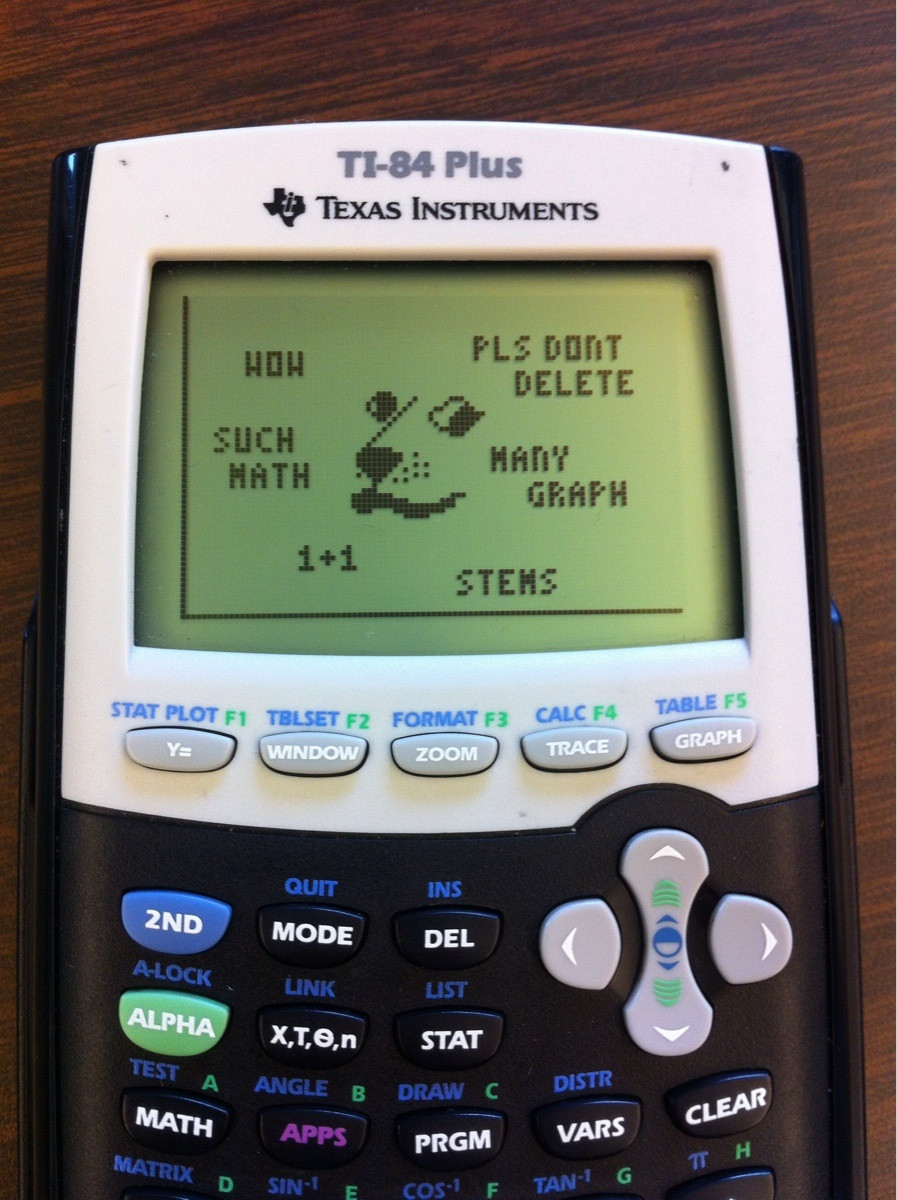
Spelling BOOBS? Times have changed my friend. Kids these days make memes using graphing equations


Wackymon

New member
Jul 22, 2011
12,850
0
0
I'd use a calculator all the time, but it requires too much thought for anything below Trig. Writing the equation down just seems easier.
 

Simple Bluff

New member
Dec 30, 2009
580
0
0
I know this is incredibly pretentious of me, but subtraction, addition, multiplication, division == calculations. Calculations =/= Maths. That's like saying History is Maths because dates are made up of numbers.

Anyway, calculators are fine. Everyone knows how to subtract, you idiots. They might be slow at it, but they still know what subtraction is. And it's actually a very easy skill to develop with repetition. If the guy at the shop can't do sums fast enough then it's either because he's new, or suffers from that "maths dyslexia" thing (whose actual name escapes me now). Actual engineers, economists, etc. all use computers anyway. You may as well give out to people for typing things into computers as opposed to using pen and paper. Who knows, if schools keep that up, then maybe the entire human race might suddenly forget how to write some day.

We must band together now to stop the menace to privileged society that is public schooling.
 

Someone Depressing

New member
Jan 16, 2011
2,416
0
0
I've only used a calculator in school to do pythagoras, tangents, and because I'm incapable of doing it on my own because it's the most contrived and useless area in mathematics, arithmatic and general equation, long division and multiplication.

But really, some people's trains of thought just completely crash and burn when it comes to maths. I'm one of them. And no, I don't think anyone with the same amounts of skill in arithmatic or percentage should be working in a position that requires apt skill in arithmatic or percentage.
 

Yuuki

New member
Mar 19, 2013
995
0
0
I agree that children need to be made fluent with solving basic equations in their head on-the-fly, but all the long-hand stuff is largely useless. Remember that the entire POINT of long-hand is to break equations down to smaller numbers that we can calculate in our brain, it still boils down to fast calculations with small numbers.
Please can be taught all the long-hand stuff, but if they don't use it on a regular basis they will quickly forget it.

The most mathematics anyone needs to be able to do is on-the-fly +/-X with small numbers, i.e. the "quick" stuff.
I can do fast multiplication (e.g. 20x50) but if you give me weird numbers (e.g. 23x57) I'll still be able to do it, it's just that it will take me far longer - too long, might as well use a calculator. There are fast tricks to those, I used to know all those when I was back in school...but yeah, those are long forgotten because I haven't needed them.
 

TheUsername0131

New member
Mar 1, 2012
88
0
0
Fractral said:
TheUsername0131 said:
Fractral said:
I personally avoid using calculators except for things like trigonometry, where it's unavoidable, and very long sums like matrix multiplications, where doing it longhand is pointless and boring. I'm currently in my last year of sixth form, taking double maths and the further we go the less useful calculators become- they can't do symbolic calculus, they can't do matrix transformations (easily) and they can't do plane mappings- and it pains me to see the other people in my class reach for the calculator at the first sign of something as scary as a 2 digit multiplication. These are people who have aced the first year, yet get stumped by simple arithmetic.
That said, for somebody who is never going to use maths again, I don't see the point of making them do it longhand. It's slow, they may get it wrong and it's unlikely that anybody is going to be without a calculator very often, now that phones can do arithmetic for you.


For the past six years a series of calculators available can perform all those tasks you have just listed, and the old TI-92 model from 1995 can perform some of the functions you've just described.

The TI-Nspire CAS (2007) can also play gameboy and gameboy colour games in sixteen shades of grey.
Mmm, really? We're not allowed to use anything like that in exams or school. I stand corrected, though. Can calculators prove things yet, e.g by induction?
For Engineering subjects there available, for the maths courses there not: You must show full working.

The calc goes beyond standard numerical operations; it performs Trigonometry, Matrices, Vector calculations, Algebra, Calculus (as well as ordinary, linear and partial; differential equations;) Probability, Statistics and programming a bit more ubiquitous then BASIC assembly language, having the closest meaningful semblance to informal high-level description of the operating principles involved with 'If,' 'And,' 'While,' 'EndIf,' 'EndPgrm,' etc.

It also converts between the standard SI units, metric and imperial measures, holds most of the experimentally verified physical constants to a reasonable number of digits of precision. And can perform operations with numbers up too about (and a bit over) three-hundred digits.

The extended character space provides all the symbols associated with mathematics and formal logic, such that it would be a cursorily task to implement proof by logic algorithms and store them as retrievable functions.

So in a really, longwinded (sales pitch.) Yes, yes it can. But I wouldn't recommend it.

You'd be better off performing that task with a high-end computer or Computer cluster optimised for that task. Depending off course what you'd like done.

32767 digits of precision is way, way over what you need to model a dynamic system accurately. You don't even need seventy-nine digits. A model for a physical system hasn't been verified beyond a dozen digits of precision.

Now that you pose the question, the calculator's microcontroller based on the Z80 architecture can be used generate proofs of induction and then verified by mathematical induction.

But let us not detract from the fact that it can play gameboy and gameboy colour games (in sixteen shades of grey. I have yet to verify this with latter models that have colour displays.)

All it needs to do is be able to print money, specifically used, non-sequentially serial numbered bank notes that will not destabilise the world economy.
 

TheUsername0131

New member
Mar 1, 2012
88
0
0
"In the distant future, humans live in a computer-aided society and have forgotten the fundamentals of mathematics, including even the rudimentary skill of counting.?
-The Feeling of Power by Isaac Asimov (1958)


http://en.wikipedia.org/wiki/The_Feeling_of_Power

[Snippets of the text below.]

Congressman Brant took out his computer a second time and flicked it, "By Godfrey, so it is. How did he guess?"

"No guess, Congressman," said Shuman. "He computed that result. He did it on this sheet of paper."

"Humbug," said the general impatiently. "A computer is one thing and marks on paper are another."

*********************************************
"Computing without a computer," said the President impatiently, "is a contradiction in terms."

"Computing," said the Congressman, "is only a system for handling data. A machine might do it, or a human brain might. Let me give you an example." And using the new skills he had learned, he worked out sums and products until the president, despite himself, grew interested.

"Does this always work?"

"Every time, Mr. President. It is foolproof."

"Is it hard to learn?"

It took me a week to get the real hang of it. I think you would do better.

"Well," said the President, considering, "it's an interesting parlor game, but what is the use of it?"

"What is the use of a newborn baby, Mr. President? At the moment there is not use, but don't you see that this points the way toward liberation from the machine? Consider, Mr. President," the congressman rose and his deep voice automatically took on some of the cadences he used in public debate, "that the Denebian war is a war of computer against computer. Their computers forge an impenetrable shield of counter-missiles against our missiles, and ours forge one against theirs. If we advance the efficiency of our computers, so do they theirs, and for five years a precarious balance has existed.

"Now, we have in our hands a method of going beyond the computer, leapfrogging it, passing through it. We will combine the mechanics of computation with human thought; we will have the equivalent of intelligent computer, billions of them. I can't predict what the consequences will be in detail, but they will be incalculable. And if Deneb beats us to the punch, they may be unimaginably catastrophic."
*********************************************

"Put the power of the administration behind the establishment of a secret project on human computation. Call it Project Number, if you like. I can vouch for my committee, but I will need the administration behind me."

"But how far can human computation go?"

"There is no limit. According to Programmer Shuman, who first introduce me to his discovery-"

"I've heard of Shuman, of course."

"Yes. Well, Dr. Shuman tells me that in theory there is nothing the computer can do that the human mind cannot do. The computer merely takes a finite amount of data and performs a finite number of operations upon them. Then human mind can duplicate the process."

The President considered that. He said, "If Shuman says this, I am inclined to believe in - in theory. But in practice, how can anyone know how a computer works?"

Brant laughed genially. "Well, Mr. President, I asked the same question. It seems that at one time computers were designed directly by human beings. Those were simple computers, of course, this being before the time of the rational use of computers to design more advanced computers had been established.

"Yes, yes. Go on."

"Technician Aub apparently had, as his hobby, the reconstruction of some of these ancient devices, and in so doing, he studied the details of their workings and found he could imitate them. The multiplication I just performed for you is an imitation of the workings of a computer."

"Amazing!"

The congressman coughed gently. "If I may make another point, Mr. President - the further we can develop this thing, the more we can divert our federal effort from computer production and computer maintenance. As the human brain takes over, more of our energy can be directed into peacetime pursuits and the impingement of war on the ordinary man will be less. This will be most advantageous for the party in power, of course."

"Ah, said the President, "I see your point, Well sit down, Congressman, sit down I want some time to think about this, But meanwhile, show me that multiplication trick again. Let's see if I can't catch the point of it."

*********************************************


But Loesser was holding back. He said, "I'm not sure I like the idea of relaxing our hold on computers. The human mind is a capricious thing. The computer will give the same answer to the same problem each time. What guarantee have we that the human mind will do the same?"

"The human mind, Computer Loesser, only manipulates facts. It doesn't matter whether the human mind or a machine does it. They are just tools.

"Yes, yes. I've gone over your ingenious demonstration that the mind can duplicate the computer, but it seems to me a little in the air. I'll grant the theory but what reason have we for thinking that theory can be converted to practice?"

"I think we have reason, sir. After all, computers have not always existed. The cave men with their stone axes, and railroads had no computers."

"And possibly they did not compute."

"You know better than that. Even the building of a railroad or a ziggurat called for some computing, and that must have been without computers as we know them."

"Do you suggest they computed in the fashion you demonstrate?"

"Probably not. After all, this method - we call it 'graphitics,' by the way, from the old European word 'grapho,' meaning 'to write' - is developed from the computers themselves so it cannot have antedated them. Still, the cave men must have had some method, eh?"

"Lost arts! If you're going to talk about lost arts -"

"No, no. I'm not a lost-art enthusiast, though I don't say there may not be some. After all, man was eating grain before hydroponics, and if the primitives ate grain, they must have grown it in soil. What else could they have done?"

"I don't know, but I'll believe in soil-growing when I see someone grow grain in soil. And I'll believe in making fire by rubbing two pieces of flint together when I see that too."

 

sth1729

New member
Jul 6, 2013
26
0
0
You mention a cashier but that doesn't make any sense, a cash register is a calculator.
The issue you describe seems more to do with not being properly trained for the register, not being poor at math.

But in regards to the issue at hand you really only need to know how to add, subtract, and count properly, pretty much everything up to trigonometry is just those three things in some form. Calculators replacing long-hand is just kinda necessary too, calculators are far faster and more accurate than long-hand if used properly, and nearly everybody carries around a small computerized device that can quickly and easily be used as a calculator. Not to say long-hand is useless, but for the average person a calculator is pretty much all they will ever need.
 

Trippy Turtle

Elite Member
May 10, 2010
2,119
2
43
At this point in my math classes it would be impossible without calculators, unless you know of a fast, efficient way to work things out rounded to 17 decimal places.

When we were doing basic things like divison to 2 decimals or less we couldn't use calculators unless it was part of a larger question, in which case it would just take time to do something we already know how to do.
 

TWRule

New member
Dec 3, 2010
465
0
0
No way - arithmetic is for calculators.

I learned math without any calculators (schools don't allow them usually) and it still takes me awhile to do mental math or longhand.

If you reserved positions where one might be expected to do basic math on their own occasionally to only those who happen to be quick at it, you've effectively put a massive percentage of the world's population out of work because your antsy self couldn't wait a couple extra minutes. Help them out with your own calculator or mental math skills if you're so impatient.
 

rasputin0009

New member
Feb 12, 2013
560
0
0
Writing this alongside my engineering calculus assignment.

Calculators are wonderful tools for simple calculations. Why wouldn't you use them? Especially when your job doesn't involve math that much. My job requires math constantly so I rely on my mental math to stay as efficient as possible, but I still double-check everything at the end of the day with a calculator.

Since a cashier or waiter/waitress is only making a small fraction of what I make in wages, I don't expect them to have the same skills or education as I do. So ya, I'm okay with people relying on calculators as much as I'm okay with people using wikipedia/internet as an information source.
 

crazygameguy4ever

New member
Jul 2, 2012
750
0
0
AccursedTheory said:
What schools allow the use of calculators? Admittedly, I've been out of school for a while, but the only time we were allowed to use them was when we were doing tangents and that other stuff. And the week where we were taught to use calculators in middle school.

On the first day of highschool, i remember one of the mandatory items to buy was a scientific calculator for math class.. and we were encouraged to use it all the time.. if you didn't have one , then the teacher let you borrow one.. of course that made sure that a lot of people didn't understand the math work cause it seemed like we weren't suppose to use our brains... if my middle school math teacher ever caught you using a calculator instead of figuring it out on your own, she give you extra homework...
 

RicoADF

Welcome back Commander
Jun 2, 2009
3,146
0
0
In my schools we only used calculators in High School (years 7-12) and even then they were used to check the results, not relied apon except I think for some advanced maths in years 11 & 12.
I can do percentages, multiplication and divisions fine, as long as I have paper and a pen in front of me.
 

Danny Ocean

Master Archivist
Jun 28, 2008
4,148
0
0
Chemical Alia said:
However, I do write everything freehand in cursive, in the hopes of someday trolling some kid who never learned it. Apparently they don't teach that anymore.
True. I was at a language school in Morocco totally rocking my taught-before-non-cursive cursive handwriting in front of all the Americans. My unintelligible scrawl was genuinely deemed "Beautiful".

Seems like the only good-looking cursive is contrived cursive. Mine just gets worse and worse. It looks like a Doctor and an Engineer had a baby, and that baby was my wrist.
 

Strazdas

Robots will replace your job
May 28, 2011
8,405
0
0
kurokotetsu said:
I don't blame schools. Calculators are mighty handy and with most celphones having one integrated, well, it is easy to see why people don't do math in the head. We should still be able to do it though. What we should give people is the "dirty" trick to solve problems. LIke that 459*15 that is up there, instead of doing the hassel that is the whole opperation, add a zero to the second number to have 4590, then divide by two (which is easy to do) to get 2295 and add these two numbers to get 6885, which I thinik it is the right answer in less than a minute (checked it, it is right). A trick, multiplyin by 15 is the same as multiplying by 5 and 10 and adding the result, so we do the ten (which is trivial, just add a zero to the number) and with that the product times five is very easy as it is half of the given number, so you can get both factors with easy calculations and just add them. We don't need to only make them do it the long way, that way is obsolete now, it is important to show the tricks to doing that in their heads quickly, especially to give people the notion of around what number should the answer be, a better numerical sense. Percetnages are easy with tricks aside from the standard wat. We don't need to drill long hand, that isn't feasible nowdays, we need to show good tricks to poeple so they can do it faster without reaching for a calculator.
very much this. i dont blame schools i blame stupid teachers. i always do the calculation like you describe in my hand ever since junior school, and teachers would always get furious for me "not writing the calculation down" because i would do it in my head.

actually i still get angry looks from my university professors when they present a ridiculously easy thing and tell us to "Calcualte" and then i proceede to claim its easy stand up and tell them the correct answer. i mean how card can it be to find 2/3 of 300.000, seriuosly!
anyone would instantly see its 200.000, but not the professors apparently.
 

Auron225

New member
Oct 26, 2009
1,789
0
0
KeyMaster45 said:
Clive Howlitzer said:
While we are at it, we should get rid of cars. I feel peoples legs aren't being tested enough, we should go back to walking. Let us also remove all written records, memory isn't what it used to be. Also, please immediately remove your computer, it is making you weak.
Soon you can discard all technology and rely solely on your 'superior' natural instincts.
This post was going to be written, but the user had an epiphany after reading the quoted post; they hurled their PC from their second story dormitory window.

This user in question went on to live in the darkest swampy parts of Louisiana as a roaming nomad-master of the wilderness. He clothes himself in nutria rat skins; wields the sharpened beak of a pelican tied to a cypress branch, and carries a shield made from a magnolia tree trunk; and he travels the swamps atop the back of his alligator mount named T-Charles.

The locals have given a name to this legend of a man, but nobody can understand it through their thick Cajun accents.

To Clive Howlitzer he sends a fresh bounty of illegally harvested alligator meat and skins; to everyone else in this thread he sends his ever-lasting thanks for showing him the light.


This automated message was possible via a message written in blood on the back of a beaver skin, that was found at the edge of the swamp.
You win the thread :D

OT: You stood there for 20 minutes and waited? And you're not exaggerating? How long was the queue behind you that this person needed 20 minutes to work that out? And why didn't you just do it for him/her?

After 1 minute I'd have done it myself and the person in question would probably have been very grateful for the assistance.
In 20 minutes I could have tutored the person somewhat so it doesn't happen quite as often in the future.
What I wouldn't have done was stood there and watched them sweat.
 

Chemical Alia

New member
Feb 1, 2011
1,657
0
0
Danny Ocean said:
Chemical Alia said:
However, I do write everything freehand in cursive, in the hopes of someday trolling some kid who never learned it. Apparently they don't teach that anymore.
True. I was at a language school in Morocco totally rocking my taught-before-non-cursive cursive handwriting in front of all the Americans. My unintelligible scrawl was genuinely deemed "Beautiful".

Seems like the only good-looking cursive is contrived cursive. Mine just gets worse and worse. It looks like a Doctor and an Engineer had a baby, and that baby was my wrist.
Oh, same here. I have the handwriting of a thousand madmen who grow madder with each passing day. Anyone who successfully reads what I write must feel a deep sense of accomplishment. But I do hate writing out sympathy cards for friends and coworkers, it always ends up looking like a serial killer left someone a warning.
 

McMullen

New member
Mar 9, 2010
1,334
0
0
amaranth_dru said:
Its pretty simple. There are times I've gone to a store or restaurant and the cashier has an issue ringing up something or taking off a coupon. They spend 20 minutes or more trying to figure out how to subtract the coupon amount from the non-taxed total because:

A. They don't have a calculator handy
B. They don't know how to do subtraction or percentages

This is just stupid and I blame schools for allowing kids to use calculators in place of learning math on their own. Its not a guarantee you will have a calculator when you really need one and knowing simple math is extremely handy. Sure there are folk who just aren't good at numbers, and need calculators but still I don't think they should be working in a position where they potentially need to use math without assistance.

Do you agree or disagree and why
There are other reasons to use calculators; math is more than just arithmetic, and much time has been wasted by continuing to emphasize manual computation in pre-calc and up.

As an example, I invite you to calculate the semivariance of monthly global average temperature over the past ten years using all possible whole-month lags by hand, and then come back and say whether your time was well spent. It's not hard; you just do a series of simple arithmetic operations on all pairs of data points separated by a certain distance. Then you do it again for all pairs separated by the next larger distance, and so on until there are no pairs separated by a greater distance than the one you just used. If you're diligent, keep good records, and can stay focused, I think you should be able to get it done in one working day.

My students, in order to move on with their assignments in an efficient manner, should generally be able to do this in about, oh, ten to thirty minutes, depending on how they go about it. Lots to cover, you know.

Now this is an extreme example, but it illustrates the point: arithmetic is great and all for daily life, but it is not the point of math. And no, not all people are equally good at it. I got As in both calculus classes I took, but will still take a while to mentally compute 67-18, even though we had daily drills in first grade in which we filled (or in my case, tried to fill) a sheet of about 40 arithmetic questions in a minute.

I don't think removing calculators will solve any problems. In fact, I would wager that this would be a nearly guaranteed way to make math education even less effective than it is now. I was a D and F student in math classes that emphasized manual computation. I barely got Cs in my junior college math classes, both of which I had to drop and re-attempt first. Then I got into a field where I used math, but not in the way it was taught; here, math was a means, not an end, and the computation was done by computer. I was thinking about it in conceptual terms, dealing with vector algebra in three dimensions every day, but never actually calculating anything myself. I just had to know how to build an equation that would do what I wanted. After a couple years of this I took calculus and aced it, started programming, and now teach a statistics lab at my university. This all happened once the point of math stopped being the calculation of specific values; once it stopped being about what the equation produced and started being about what it does. I stayed up till 2 last night doing math because I was having fun, and in that time I only calculated one product by hand to check what I was doing. The computer, on the other hand, performed several billion calculations, and as a result I was able to generate a set of maps showing the data I was trying to display.

This makes me wonder how many other people could have loved math, but never did because they were taught it in a way that only emphasized manual computation. I imagine that nearly everyone who hates math could probably have been taught to value it, if the emphasis had been different. I think it would improve things to see a little more of this (and there are efforts to introduce alternative teaching methods which emphasize the approach I used above, which have so far been meeting with success), and a lot less emphasis on manual computation, at least after first grade.
 

DudeistBelieve

TellEmSteveDave.com
Sep 9, 2010
4,768
1
0
amaranth_dru said:
Its pretty simple. There are times I've gone to a store or restaurant and the cashier has an issue ringing up something or taking off a coupon. They spend 20 minutes or more trying to figure out how to subtract the coupon amount from the non-taxed total because:

A. They don't have a calculator handy
B. They don't know how to do subtraction or percentages

This is just stupid and I blame schools for allowing kids to use calculators in place of learning math on their own. Its not a guarantee you will have a calculator when you really need one and knowing simple math is extremely handy. Sure there are folk who just aren't good at numbers, and need calculators but still I don't think they should be working in a position where they potentially need to use math without assistance.

Do you agree or disagree and why
As a cashier that can't do any form of math in my head (can't even do percentages with out first writing down the formula) generally the cash register does all the work. I literally could be replaced with a uscan machine if costumers actually liked using them.

though I agree with you that Calculators are the problem. I wasn't terribly great at math to begin with, and calculators greatly exasperated the problem.